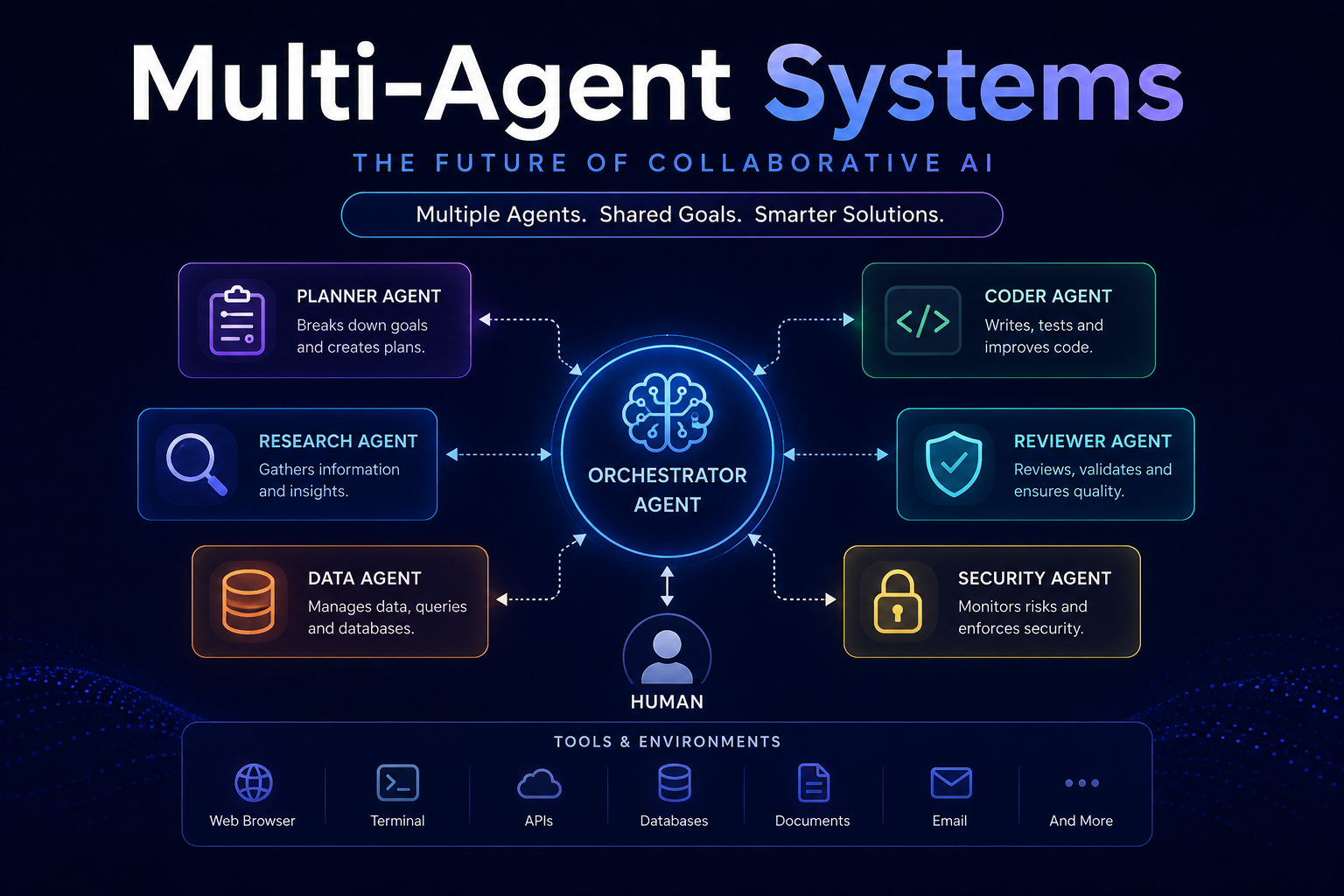
Artificial intelligence is moving beyond isolated, single‑purpose models toward networks of cooperating agents. Multi‑agent systems (MAS) combine specialized AI modules that communicate, negotiate, and adapt in real time. For companies, founders, designers, and developers, this shift promises faster problem solving, more resilient products, and new business models. This article explains the core concepts of MAS, highlights real‑world deployments, and outlines practical steps for turning collaborative AI into a strategic advantage.
Understanding Multi‑Agent Systems
A multi‑agent system consists of two or more autonomous agents that share a common environment and pursue individual or joint goals. Each agent can be a narrow AI model, a rule‑based bot, or a full‑stack software service. The key characteristics are:
- Autonomy: Agents make decisions without human intervention.
- Social interaction: Agents exchange messages, coordinate actions, and resolve conflicts.
- Distributed problem solving: Complex tasks are broken into sub‑tasks handled by the most suitable agent.
- Adaptability: The collective can re‑organize when agents join, leave, or change capabilities.
From a technical perspective, MAS builds on concepts such as reinforcement learning, game theory, and distributed computing. The architecture typically includes:
- Perception layer – sensors or data streams that feed each agent.
- Decision layer – algorithms (e.g., deep learning, planning) that generate actions.
- Communication protocol – messages (REST, gRPC, message queues) that coordinate agents.
- Execution layer – actuators, APIs, or UI components that act on the environment.
Why Companies Are Investing in Collaborative AI
Businesses that adopt MAS gain strategic benefits that single‑model AI cannot deliver.
- Scalability: Workloads can be distributed across agents, allowing seamless scaling from a prototype to an enterprise‑grade solution.
- Robustness: Failure of one agent does not cripple the entire system; other agents can compensate or reassign tasks.
- Specialization: Teams can develop best‑in‑class agents for niche functions (e.g., legal compliance, image analysis) and let them collaborate.
- Speed of innovation: New capabilities are added by plugging in additional agents rather than retraining monolithic models.
These advantages align with the current priorities of technology‑driven startups: rapid go‑to‑market, lean engineering, and data‑centric product differentiation.
Real‑World Deployments of Multi‑Agent Systems
Several pioneers have demonstrated MAS at scale. Below are three varied examples that illustrate how collaborative AI is reshaping industries.
1. Autonomous Vehicle Fleets – Waymo
Waymo’s self‑driving fleet relies on a network of agents:
- Perception agents process lidar, radar, and camera data to detect obstacles.
- Planning agents generate trajectories for lane changes, merges, and stops.
- Coordination agents communicate between vehicles to optimize traffic flow and avoid collisions.
By distributing tasks, Waymo reduces latency, improves safety, and can update individual agents (e.g., a new traffic‑rule module) without redeploying the entire stack.
2. AI‑Driven Content Teams – CrewAI
CrewAI offers a platform where multiple specialized agents assemble marketing copy, visual assets, and performance analytics. The workflow includes:
- Research agent extracts market insights from public data.
- Copywriting agent drafts headlines using a fine‑tuned language model.
- Design agent generates UI mockups with a diffusion model.
- Optimization agent predicts conversion rates and suggests revisions.
Clients report a 40 % reduction in time‑to‑publish and a measurable lift in engagement, demonstrating how MAS can replace a traditional creative team with a digital counterpart.
3. Enterprise Knowledge Management – IBM Watson Orchestrate
Watson Orchestrate employs a suite of agents that automate routine business processes:
- Scheduling agent: aligns calendars across time zones.
- Data‑retrieval agent: pulls relevant reports from enterprise repositories.
- Insight agent: runs analytics and drafts executive summaries.
The agents negotiate task ownership and priority, delivering end‑to‑end workflow automation without requiring extensive custom coding.
Designing User Experiences for Collaborative AI
When multiple agents interact, the user interface must convey their collective intent without overwhelming the user. Effective UI/UX design follows three principles:
- Transparency: Show which agent performed an action and why, using tooltips or activity logs.
- Control: Allow users to intervene, pause, or reassign tasks among agents through simple toggles.
- Consistency: Use unified visual language (icons, color codes) to represent agent types (e.g., analysis, creation, execution).
Design systems such as Material Design or Carbon Design System provide component libraries that can be extended with agent‑specific widgets, ensuring accessibility and brand alignment.
Development Practices that Enable Scalable Multi‑Agent Architectures
Building MAS requires disciplined engineering. The following practices reduce friction:
- Microservice orientation: Package each agent as an independent service with clear API contracts.
- Event‑driven messaging: Use lightweight brokers (e.g., NATS, RabbitMQ) to broadcast state changes and requests.
- Observability: Instrument agents with distributed tracing (OpenTelemetry) to diagnose coordination bottlenecks.
- Versioned contracts: Apply semantic versioning to agent interfaces, allowing incremental upgrades.
- Continuous simulation: Run automated multi‑agent simulations in CI pipelines to validate emergent behavior before production release.
Adopting these practices lets development teams iterate quickly while preserving the integrity of the overall system.
Strategic Innovation: How Founders Can Leverage Multi‑Agent Systems
For entrepreneurs, MAS opens new product categories and revenue streams. Consider the following roadmap:
- Identify a fragmented workflow: Look for processes where multiple specialists currently collaborate (e.g., legal review + contract drafting + approval).
- Define agent roles: Map each specialist’s function to a potential autonomous agent.
- Prototype with low‑code frameworks: Tools like LangChain or Auto‑GPT enable rapid assembly of agents without deep RL expertise.
- Validate market fit: Deploy a minimal viable MAS to a single client and measure efficiency gains.
- Scale through modularity: Expand the agent ecosystem by adding niche capabilities (e.g., sentiment analysis) as separate services.
This approach reduces upfront R&D costs while delivering a differentiated AI product that can evolve alongside customer needs.
Future Trends Shaping Collaborative AI
Industry analysts predict three major trajectories for MAS over the next five years:
- Standardized communication protocols: Emerging specifications (e.g., FIPA‑MAS, OpenAI‑Coop) will simplify integration across vendors.
- Hybrid human‑agent teams: Interfaces will blend human expertise with autonomous agents, allowing seamless handoff and joint decision‑making.
- Self‑optimizing ecosystems: Agents will use meta‑learning to reconfigure their collaboration strategies based on performance metrics, reducing the need for manual orchestration.
Enterprises that adopt these trends early will gain a durable competitive edge in product innovation, operational efficiency, and talent acquisition.
Conclusion
Multi‑agent systems represent a decisive evolution from isolated AI models to collaborative, adaptive networks. By distributing intelligence across specialized agents, companies can achieve scalability, robustness, and rapid innovation that traditional monolithic approaches cannot match. Real‑world deployments—from autonomous vehicle fleets to AI‑powered content studios—demonstrate tangible value across sectors. For founders, designers, and developers, the path forward involves mapping complex workflows to agent roles, embracing modular, event‑driven architectures, and prioritizing transparent user experiences. As standards mature and human‑agent collaboration deepens, MAS will become the backbone of next‑generation AI products, shaping the future of technology‑driven business.